Friday, 2 January 2015

Seeing good in everyone


Many times when we are placed in trying situations, we lose our patience and try to always retaliate the people who trouble us. Even if that person is elder or younger to us, anger blinds us. And all we want is to shout back and prove that we are right and that they are wrong. In that process we become despondent and then hamper our progress in spiritual advancement.
In his purport to verse 13.8 through 12 of Bhagavad Gita, Srila Prabhupada very nicely explains what tolerance is and the importance of practising it in our lives. "Even a boy like Prahlada, who, only five years old, was engaged in the cultivation of spiritual knowledge, was endangered when his father became antagonistic to his devotion. The father tried to kill him in so many ways, but Prahlada tolerated him. So there may be many impediments to making advancement in spiritual knowledge, but we should be tolerant and continue our progress with determination."

Whatever troubles we face in life are nothing when compared to the troubles which Pandavas underwent in their life. That is why Bhishmadev says in Srimad Bhagavatam verse 1.19.12

aho kashtam aho 'nyaayyam / yad yuyam dharma nandanah
jivitum naarhata klishtam / vipra dharmaacyutaashrayaah

Bhishmadeva said: "Oh, what terrible sufferings and what terrible injustices you good souls suffer for being the sons of religion personified. You did not deserve to remain alive under those tribulations, yet you were protected by the brahmanas, God and religion."

Srila Prabhupada very nicely mentions the secret of success of Pandavas lives -"As long as a person is fully in cooperation with the wishes of the Lord, guided by the bona fide brahmanas and Vaishnavas and strictly following religious principles, one has no cause for despondency, however trying the circumstances of life." 

When Draupadi was insulted in the assembly of Kauravas, Bhima became very furious. Thinking that Yudhishtira is the cause of all the problems, he shouted in anger that he wanted to burn the hands of Yudhishtira, for having lost Draupadi in the game of dice. But Arjuna told him, "Bhima, you have never uttered words like this. Your morality has been destroyed by these cruel foes. But please do not fulfill the wishes of the enemy. Practise thou the highest morality. Yudhishtir Maharaj being a kshatriya cannot refuse to play dice when he had been invited for the same." Bhima could then understand that Yudhishtir Maharaj was not at fault, but still was unable to bear the insulting words of Kauravas and Karna. At that time Arjuna pacified him by saying, "Superior person do not meditate at length the harsh words uttered by inferior men. Persons that have earned respect for themselves, even if they are able to retaliate, remember not the acts of hostility done by their enemies, but, on the other hand, treasure up only their good deeds." When Pandavas lost their father Pandu when they were young, Dhrtarashtra had given them shelter. So even though Kauravas annd Dhrtarashtra are behaving in a very harsh manner Arjuna advised Bhima to think of the good deeds which they had done in the past.

It is very difficult for us to practice tolerance on our own in our lives. Our beloved Maharaj says, "If you see always good in everyone, then you become good. But if we lose our tolerance and see only bad things, then in due course we are sure to become bad. So for our own well being we should tolerate, forgive and forget the fact that we have forgiven others". Also by always remembering how these great devotees have faced insults even in trying situations, then by mercy of Guru and Krishna we will also get an iota of that quality and practise the same in our lives. 

Sri Krishna and Jesus Christ


Many people often wonder what is the view of Lord Jesus Christ in the Krishna consciousness movement.
Srila Prabhupada, the foremost exponent of the Krishna consciousness movement explains that Jesus is Krishna's representative, son of God, and spiritual master.
Below are excerpts from Srila Prabhupada's books, lectures, and conversations about Jesus Christ and his relationship with Krsna.
"If one loves Krishna, he must love Lord Jesus also. And if one perfectly loves Jesus he must love Krishna too. If he says, "Why shall I love Krishna? I shall love Jesus," then he has no knowledge. And if one says, "Why shall I love Jesus? I shall love Krishna", then he has no knowledge either. If one understands Krishna, then he will understand Jesus. If one understands Jesus, you'll understand Krishna too" (Srila Prabhupada - Room conversation with Allen Ginsberg, May 12, 1969 / Columbus - Ohio)
As Lord Jesus Christ said, we should hate the sin, not the sinner. That is a very nice statement, because the sinner is under illusion. He is mad. If we hate him, how can we deliver him? Therefore, those who are advanced devotees, who are really servants of God, do not hate anyone. When Lord Jesus Christ was being crucified, he said, "My God, forgive them. They know not what they do." This is the proper attitude of an advanced devotee. He understands that the conditioned souls cannot be hated, because they have become mad due to their materialistic way of thinking. In this Krsna consciousness movement, there is no question of hating anyone. Everyone is welcomed to come and chant Hare Krsna, take krsna-prasada, listen to the philosophy of Bhagavad-gita, and try to rectify material, conditioned life. This is the essential program of Krsna consciousness. (Path of Perfection Chapter 3: Learning How to See God)
Christian, Muhammadan, Hindu-it doesn't matter. If he is simply speaking on behalf of God, he is a guru. Lord Jesus Christ, for instance. He canvassed people, saying, "Just try to love God." Anyone-it doesn't matter who-be he Hindu, Muslim, or Christian, is a guru if he convinces people to love God. That is the test. The guru never says, "I am God," or "I will make you God." The real guru says, "I am a servant of God, and I will make you a servant of God also." It doesn't matter how the guru is dressed. As Caitanya Mahaprabhu said, "Whoever can impart knowledge about Krsna is a spiritual master." A genuine spiritual master simply tries to get people to become devotees of Krsna, or God. He has no other business. (Science of Self Realization Chapter 2: Choosing a Spiritual Master)
So Lord Jesus Christ said, "My Lord, hallowed be Thy name." He wants to glorify the name of the Lord. And some people says that there is no name of God. How? If Lord Jesus Christ says "Hallowed by Thy name," there must be name. The name is there, but he did not pronounce it because the people at that time will not be able to understand or maybe some reason, but he says there is name. So we are making this propaganda, Krsna consciousness movement, the "Hallowed by Thy name. My Lord Krsna, the Personality of Godhead, let Your holy name be glorified." This is our movement. It is not a sectarian. (Lecture: Bhagavad Gita 3.27 Melbourne June 27, 1974)
Sometimes Sri Krsna descends Himself, and sometimes He sends His representative. The major religions of the world-Christian, Hindu, Buddhist and Moslem-believe in some supreme authority or personality coming down from the kingdom of God. In the Christian religion, Jesus Christ claimed to be the son of God and to be coming from the kingdom of God to reclaim conditioned souls. As followers of Bhagavad-gita, we admit this claim to be true. So basically there is no difference of opinion. In details there may be differences due to differences in culture, climate and people, but the basic principle remains the same-that is, God or His representatives come to reclaim conditioned souls. (Raja Vidya Chapter 6: Knowledge of Krsna's Appearance and Activities)
Just like Lord Jesus Christ. He was so badly treated and still he was thinking, "Father, they do not know what they are doing. Please excuse." This is suhrdah. He is praying to God This is sadhu, mahatma. Suhrdah prasanta. Not that In India there are examples like Haridasa Thakura, Prahlada Maharaja. And the Western countries also, Lord Jesus Christ, he is saktyavesa-avatara, God's son. And he tolerated so much. These are the examples of mahatma. Don't misunderstand that we are preaching that mahatmas are only in India. No. By the order of the Supreme Personality of Godhead there are mahatmas even among the birds, even among the beasts, even among the lower than animals. Because this Krsna consciousness movement is going on in different places, in different circumstances.(Srimad Bhagavatam 5.5.3 --vrndavana Oct 25, 1976)
Conversation with Father Emmanuel - In 1974, near ISKCON's center in Frankfurt am Main, West Germany, Srila Prabhupada and several of his disciples took a morning walk with father Emmanuel Jungclaussen, a Benedictine monk from Niederalteich Monastery. Noticing that Srila Prabhupada was carrying meditation beads similar to the rosary, Father Emmanuel explained that he also chanted a constant prayer: "Lord Jesus Christ, be merciful unto us." The following conversation ensued.
Conversation with Cardinal Danielou - "Thou Shalt Not Kill" or "Thou Shalt Not Murder"?
At a monastic retreat near Paris, in July of 1973, Srila Prabhupada talked with Cardinal Jean Danielou: "... the Bible does not simply say, `Do not kill the human being.' It says broadly, `Thou shalt not kill.'.. why do you interpret this to suit your own convenience?"
From Perfect Questions, Perfect Answers - Discussions between Peace Corps Worker Bob Cohen and His Divine Grace A.C. Bhaktivedanta Swami Prabhupada
Jesus Christ Was a Guru - The spiritual leader of the Hare Krsna movement here recognizes Lord Jesus Christ as "the son of God, the representative of God... our guru... our spiritual master," yet he has some sharp words for those who currently claim to be Christ's followers...
A devotee of Krsna is friendly to everyone. Therefore it is said here that he has no enemy (nirvairah). How is this? A devotee situated in Krsna consciousness knows that only devotional service to Krsna can relieve a person from all the problems of life. He has personal experience of this, and therefore he wants to introduce this system, Krsna consciousness, into human society. There are many examples in history of devotees of the Lord who risked their lives for the spreading of God consciousness. The favorite example is Lord Jesus Christ. He was crucified by the non devotees, but he sacrificed his life for spreading God consciousness. Of course, it would be superficial to understand that he was killed. Similarly, in India also there are many examples, such as Thakura Haridasa and Prahlada Maharaja. Why such risk? Because they wanted to spread Krsna consciousness, and it is difficult. A Krsna conscious person knows that if a man is suffering it is due to his forgetfulness of his eternal relationship with Krsna. Therefore, the highest benefit one can render to human society is relieving one's neighbor from all material problems. In such a way, a pure devotee is engaged in the service of the Lord. Now, we can imagine how merciful Krsna is to those engaged in His service, risking everything for Him. Therefore it is certain that such persons must reach the supreme planet after leaving the body. (Chapter 11 Bhagavad gita text 55 purport)


"Chant Hare Krishna and be happy"हरे कृष्ण हरे कृष्ण कृष्ण कृष्ण हरे हरे || हरे राम हरे राम राम राम हरे हरे||

Wednesday, 24 December 2014

Why did Lord Krishna appeared as Chaitanya Mahaprabhu ?

Question : What were the three external reasons for appearance of Sri Chaitanya Mahaprabhu ?
Ans: Srila Prabhupada writes in the summary of third chapter of Adi Lila :
The Supreme Personality of Godhead, Lord Śrī Kṛṣṇa, after displaying His pastimes as Lord Kṛṣṇa, thought it wise to make His advent in the form of a devotee to explain personally the transcendental mellows of reciprocal service and love exchanged between Himself and His servants, friends, parents and fiancīes. only Kṛṣṇa Himself can explain the confidential loving service performed in the four principal varieties of loving affairs between the Supreme Lord and His devotees. Lord Kṛṣṇa therefore personally appeared, with His plenary portions, as Lord Caitanya.
CC Ādi 3.13: Lord Kṛṣṇa enjoys His transcendental pastimes as long as He wishes, and then He disappears. After disappearing, however, He thinks thus:
CC Ādi 3.14: “For a long time I have not bestowed unalloyed loving service to Me upon the inhabitants of the world. Without such loving attachment, the existence of the material world is useless.
CC Ādi 3.15: “Everywhere in the world people worship Me according to scriptural injunctions. But simply by following such regulative principles one cannot attain the loving sentiments of the devotees in Vrajabhūmi.
CC Ādi 3.16: “Knowing My opulences, the whole world looks upon Me with awe and veneration. But devotion made feeble by such reverence does not attract Me.
CC Ādi 3.17: “By performing such regulated devotional service in awe and veneration, one may go to Vaikuṇṭha and attain the four kinds of liberation.
CC Ādi 3.26: “My plenary portions can establish the principles of religion for each age. No one but Me, however, can bestow the kind of loving service performed by the residents of Vraja.
CC Ādi 3.28: “Therefore in the company of My devotees I shall appear on earth and perform various colorful pastimes.”
CC Ādi 3.29: Thinking thus, the Personality of Godhead, Śrī Kṛṣṇa Himself, descended at Nadia early in the Age of Kali.
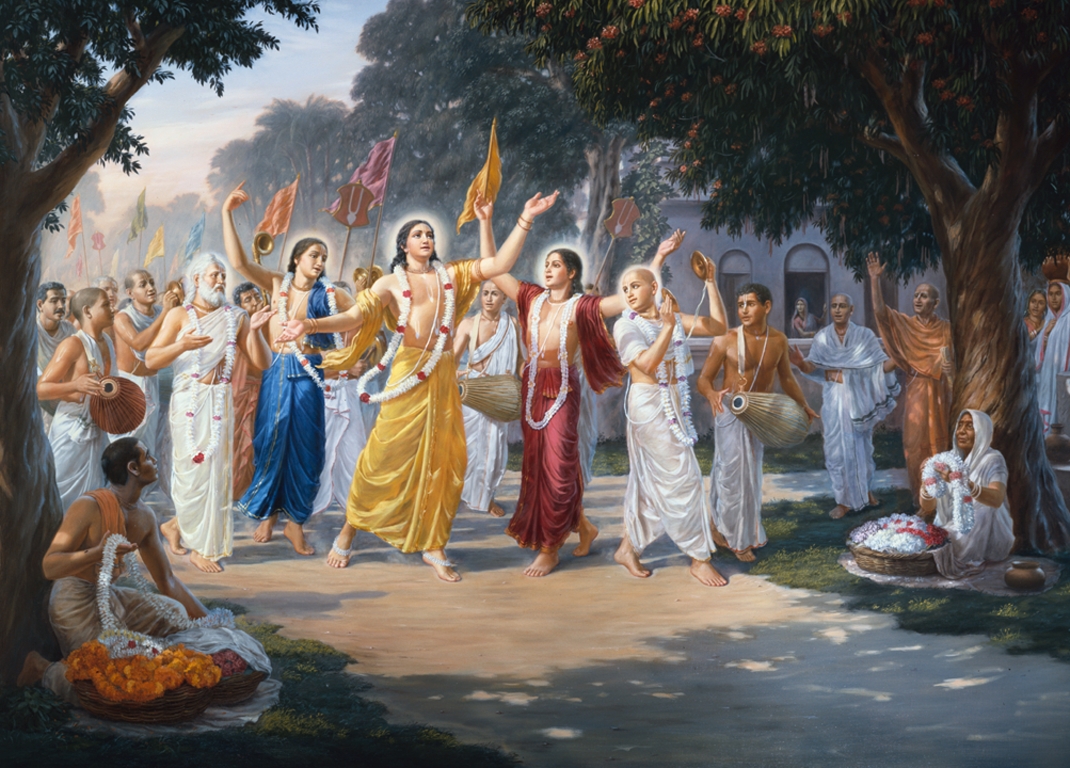
According to the Vedic literature, the foremost occupational duty for humanity in this Age of Kali is nāma-saṅkīrtana, or congregational chanting of the holy name of the Lord. Lord came as Yuga Avatara to inaugurate sankirtana movement.
F02.
CC Ādi 3.50: In Śrīmad-Bhāgavatam it is repeatedly and clearly said that the essence of religion in the Age of Kali is the chanting of the holy name of Kṛṣṇa.
CC Ādi 3.51: “O King, in this way people in Dvāpara-yuga worshiped the Lord of the universe. In Kali-yuga they also worship the Supreme Personality of Godhead by the regulations of the revealed scriptures. Kindly now hear of that from me.
CC Ādi 3.52: “In the Age of Kali, intelligent persons perform congregational chanting to worship the incarnation of Godhead who constantly sings the name of Kṛṣṇa. Although His complexion is not blackish, He is Kṛṣṇa Himself. He is accompanied by His associates, servants, weapons and confidential companions.”
CC Ādi 3.58: “By performing the sacrifice of congregational chanting of the holy name, learned scholars in the Age of Kali worship Lord Kṛṣṇa, who is now nonblackish because of the great upsurge of the feelings of Śrīmatī Rādhārāṇī. He is the only worshipable Deity for the paramahaṁsas, who have attained the highest stage of the fourth order [sannyāsa]. May that Supreme Personality of Godhead, Lord Caitanya, show us His great causeless mercy.”
Advaita Ācārya felt sorry for the condition of the world because even after Lord Kṛṣṇa’s appearance, no one had interest in devotional service to Kṛṣṇa. This forgetfulness was so overwhelming that Advaita Prabhu was convinced that no one but Lord Kṛṣṇa Himself could enlighten people about devotional service to the Supreme Lord. Therefore Advaita requested Lord Kṛṣṇa to appear as Lord Caitanya. Offering tulasī leaves and Ganges water, He cried for the Lord’s appearance. The Lord, being satisfied by His pure devotees, descends to satisfy them. As such, being pleased by Advaita Ācārya, Lord Caitanya appeared.
Advaita_Acarya
CC Ādi 3.96: Advaita Ācārya having appeared, He found the world devoid of devotional service to Śrī Kṛṣṇa because people were engrossed in material affairs.
CC Ādi 3.97: Everyone was engaged in material enjoyment, whether sinfully or virtuously. No one was interested in the transcendental service of the Lord, which can give total relief from the repetition of birth and death.
CC Ādi 3.98: Seeing the activities of the world, the Ācārya felt compassion and began to ponder how He could act for the people’s benefit.
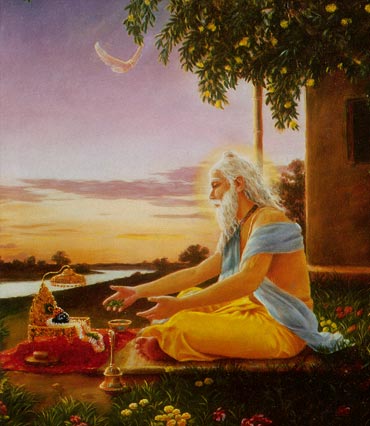
CC Ādi 3.108: Thinking of the lotus feet of Śrī Kṛṣṇa, He constantly offered tulasī buds in water from the Ganges.
CC Ādi 3.109: He appealed to Śrī Kṛṣṇa with loud calls and thus made it possible for Kṛṣṇa to appear.
CC Ādi 3.110: Therefore the principal reason for Śrī Caitanya’s descent is this appeal by Advaita Ācārya. The Lord, the protector of religion, appears by the desire of His devotee.
Question : What were the three confidential reasons for appearance of Sri Chaitanya Mahaprabhu ?
Answer:
CC Ādi 4.230: Desiring to understand the glory of Rādhārāṇī’s love, the wonderful qualities in Him that She alone relishes through Her love, and the happiness She feels when She realizes the sweetness of His love, the Supreme Lord Hari, richly endowed with Her emotions, appeared from the womb of Śrīmatī Śacī-devī, as the moon appeared from the ocean.”
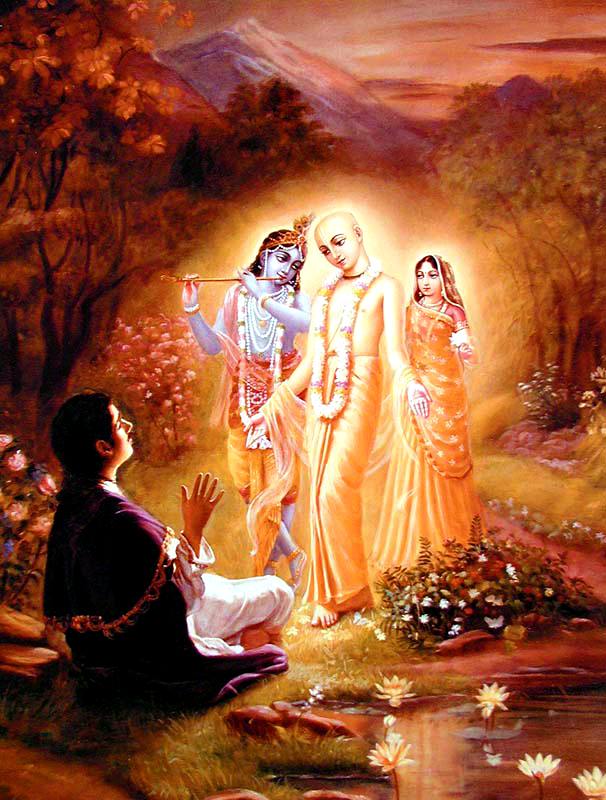
The first purpose was to relish the position of Śrīmatī Rādhārāṇī, who is the prime reciprocator of transcendental love of Śrī Kṛṣṇa. Lord Kṛṣṇa is the reservoir of transcendental loving transactions with Śrīmatī Rādhārāṇī. The subject of those loving transactions is the Lord Himself, and Rādhārāṇī is the object. Thus the subject, the Lord, wanted to relish the loving mellow in the position of the object, Rādhārāṇī.
The second reason for His appearance was to understand the transcendental mellow of Himself. Lord Kṛṣṇa is all sweetness. Rādhārāṇī’s attraction for Kṛṣṇa is sublime, and to experience that attraction and understand the transcendental sweetness of Himself, He accepted the mentality of Rādhārāṇī.
The third reason that Lord Caitanya appeared was to enjoy the bliss tasted by Rādhārāṇī. The Lord thought that undoubtedly Rādhārāṇī enjoyed His company and He enjoyed the company of Rādhārāṇī, but the exchange of transcendental mellow between the spiritual couple was more pleasing to Śrīmatī Rādhārāṇī than to Śrī Kṛṣṇa. Rādhārāṇī felt more transcendental pleasure in the company of Kṛṣṇa than He could understand without taking Her position, but for Śrī Kṛṣṇa to enjoy in the position of Śrīmatī Rādhārāṇī was impossible because that position was completely foreign to Him. Kṛṣṇa is the transcendental male, and Rādhārāṇī is the transcendental female. Therefore, to know the transcendental pleasure of loving Kṛṣṇa, Lord Kṛṣṇa Himself appeared as Lord Caitanya, accepting the emotions and bodily luster of Śrīmatī Rādhārāṇī.
Lord Caitanya appeared in order to fulfill these confidential desires, and also to preach the special significance of chanting Hare Kṛṣṇa, Hare Kṛṣṇa, Kṛṣṇa Kṛṣṇa, Hare Hare/ Hare Rāma, Hare Rāma, Rāma Rāma, Hare Hare and to answer the call of Advaita Prabhu. These were secondary reasons.
CC Ādi 4.238 — Once Lord Kṛṣṇa considered within His heart, “Everyone says that I am complete bliss, full of all rasas.
CC Ādi 4.239 — “All the world derives pleasure from Me. Is there anyone who can give Me pleasure?
CC Ādi 4.240 — “One who has a hundred times more qualities than Me could give pleasure to My mind.
CC Ādi 4.241 — “One more qualified than Me is impossible to find in the world. But in Rādhā alone I feel the presence of one who can give Me pleasure.
CC Ādi 4.242-243 — “Although My beauty defeats the beauty of ten million Cupids, although it is unequaled and unsurpassed, and although it gives pleasure to the three worlds, seeing Rādhārāṇī gives pleasure to My eyes.
CC Ādi 4.244 — “The vibration of My transcendental flute attracts the three worlds, but My ears are enchanted by the sweet words of Śrīmatī Rādhārāṇī.
CC Ādi 4.248 — “Thus although I am the source of happiness for the entire world, the beauty and attributes of Śrī Rādhikā are My life and soul.
CC Ādi 4.249 — “In this way My affectionate feelings for Śrīmatī Rādhārāṇī may be understood, but on analysis I find them contradictory.
CC Ādi 4.250 — “My eyes are fully satisfied when I look upon Śrīmatī Rādhārāṇī, but by looking upon Me, She becomes even more advanced in satisfaction.
CC Ādi 4.262 — “I am always eager to taste the joy that Rādhārāṇī derives from Me.
CC Ādi 4.263 — “In spite of various efforts, I have not been able to taste it. But My desire to relish that pleasure increases as I smell its sweetness.
CC Ādi 4.264 — “Formerly I appeared in the world to taste mellows, and I tasted the mellows of pure love in various ways.
CC Ādi 4.265 — “I taught devotional service that springs from the devotees’ spontaneous love by demonstrating it with My pastimes.
CC Ādi 4.266 — “But these three desires of Mine were not satisfied, for one cannot enjoy them in a contrary position.
CC Ādi 4.267 — “Unless I accept the luster of the ecstatic love of Śrī Rādhikā, these three desires cannot be fulfilled.
CC Ādi 4.268 — “Therefore, assuming Rādhārāṇī’s sentiments and bodily complexion, I shall descend to fulfill these three desires.”
CC Ādi 4.269 — In this way Lord Kṛṣṇa came to a decision. Simultaneously, the time came for the incarnation of the age.
OLYMPUS DIGITAL CAMERA
CC Ādi 4.231 — All these conclusions are unfit to disclose in public. But if they are not disclosed, no one will understand them.
CC Ādi 4.232 — Therefore I shall mention them, revealing only their essence, so that loving devotees will understand them but fools will not.

All glories to Sri Guru and Gauranga.
All glories to Srila Prabhupada.

Sravanam Kirtanam, Harinaam and Difference between Japa and Kirtana

Surrender - Sravanam Kirtanam

The chanting of Hare Krsna is not limited to the Kali-yuga but is applicable to other ages as well:

The easiest means of achieving spiritual success is to chant the holy names of the Lord:

If one chants even for one week, he will make solid progress in spiritual life:

Chanting produces immediate effects:

From Haridasa Thakura's personal example we can understand that becoming highly elevated in Krsna consciousness by chanting the holy name is very simple:

Devotional service begins with chanting of the holy name hearing of the holy name tasting Prasadam

Surrender begins with giving up bad habits and chanting the Hare Krsna mantra on beads:

Sankirtana and chanting as fundamental principles for the execution of devotional service:

Of the nine processes of devotional service, chanting the holy name is the most important:

Hearing of the holy name of the Lord (sravana) is the basis for understanding the other processes of devotional service:

All processes of devotional service must be preceded and followed by kirtana, which is the most important process:

Chanting of the holy name is one of the five most important practices of devotional service:


Hari-naam solution to all problems

Chanting of the holy name evokes the Vaikuntha atmosphere, freeing the world from material hankering, envy and anxiety:

"My dear Narada, actually I do not reside in My abode, Vaikuntha, nor do I reside within the hearts of the yogis, but I reside in that place where My pure devotees chant My holy name and discuss My form, pastimes and qualities." 

Nama-sankirtana can turn the masses toward spiritual realization and bring peace and friendship:

The formula for world peace is to develop Krsna consciousness by the simple process of chanting the holy name of God:

Chanting of the holy name eradicates envy, and thus can bring real peace, unity and fraternity to human society:

"Whatever action a great man performs, common men follow in his footsteps. And whatever standards he sets by exemplary acts, all the world pursues."
The sankirtana movement of Krsna consciousness is very important. Therefore, through you I wish to appeal to all the leading men of India to accept this movement very seriously and give us all facility to spread this movement throughout the world. Then there will be a very happy condition, not only in India but all over the world.

The chanting of the holy name is the only 
remedy for setting the world aright:

In this age, people can be freed from drought and scarcity of rain by congregational chanting of the holy name:

In order to counteract scarcity in this age, people must perform sankirtana-yajna, chanting of the holy names:

By performance of sankirtana-yajna, the congregational chanting of the holy name, people will be happy economically, politically, socially, religiously and culturally:

Through popularizing the chanting of the holy name, brahminical culture and ksatriya government will automatically be revived:

If we chant the holy name offenselessly, the kingdom of Rama can appear even in this Kali-yuga:

To counteract the unfortunate situation in government, the general populace should chant the maha-mantra:

In this age, saintly persons should help the general populace not by political action, but by chanting the maha-mantra:

Crime can be eradicted by mass sankirtana, which changes the heart:

Namamrita 19 & 20


The difference between japa and kirtana:

When a mantra or hymn is chanted softly and slowly, that is called japa. The same mantra, when chanted loudly, is called kirtana. For example, the maha-mantra (Hare Krsna, Hare Krsna, Krsna Krsna, Hare Hare/ Hare Rama, Hare Rama, Rama Rama, Hare Hare) when uttered very softly only for one's own hearing is called japa. The same mantra, when chanted loudly for being heard by all others, is called kirtana. The maha-mantra can be used for japa and kirtana also. When japa is practiced it is for the personal benefit of the chanter, but when kirtana is performed it is for the benefit of all others who may hear.

In the Padma Purana there is a statement: "For any person who is chanting the holy name either softly or loudly, the paths to liberation and even heavenly happiness are at once open."
The Nectar of Devotion

>>>Ref. VedaBase => NAM 2a15: Definitions: Japa, Kirtana, Sankirtana, and Sravana


Sri-krsna-caitanya prabhu nityananda sri-advaita gadadhara srivasadi-gaura-bhakta-vrinda.
Hare Krsna, Hare Krsna, Krsna Krsna, Hare Hare / Hare Rama, Hare Rama, Rama Rama, Hare Hare


"Chant Hare Krishna and be happy"हरे कृष्ण हरे कृष्ण कृष्ण कृष्ण हरे हरे || हरे राम हरे राम राम राम हरे हरे||

Who is Poor?


Once there lived a king who was very fond of conquering other countries. So
he went on fighting one war after another, and was just busy building a big
empire. Once when he was on his way back home after a war he saw a old sage
dressed in rags, sitting by the street side and meditating. Seeing him in
rags the king thought, "This old man is very poor and does not have even
proper clothes to protect him from cold. Let me gift him my shawl". Thinking
in this manner, the king approached the sage and gifted him his shawl. The
sage thanked the king for his kind gesture, but refused to accept the gift.
The sage said, "O king, there is someone more poorer than me in your kingdom
and may be you consider giving this gift to him. By mercy of Lord, I have
everything which is needed for me and so I don't want your shawl".  The king
was very surprised and he asked the sage as to who was that poor man. The
sage replied, "O king, you are the poorest man in this kingdom. Because, I
see that even though you had captured so many kingdom, still your thirst for
war has not quenched. You don't feel satisfied with what you have and you
keep on wasting your valuable time in wars." Hearing the sage's words, the
king realized that indeed since the sage had taken shelter of Holy Names,
and had the wealth of satisfaction, the sage was far more richer than him.
He thanked the sage for his valuable advice and from that day onwards, the
king took shelter of Holy Names, stopped unnecessary wars, executed his
prescribed duties to the best of his ability.  In Srimad Bhagavatam verse
11.19.43-44, Lord Krishna instructs Uddhava that

gunaadhyo hyaadhya ucyate
daridro yastv asantushtah
"My dear friend Uddhava, one who is enriched with good qualities is actually
said to be rich, and one who is unsatisfied in life is actually poor."

Indeed satisfaction is the greatest wealth. We must be completely satisfied
with whatever Krishna gives us and avoid unnecessary hankerings. That is the
secret of peaceful and blissful life. 


"Chant Hare Krishna and be happy"हरे कृष्ण हरे कृष्ण कृष्ण कृष्ण हरे हरे || हरे राम हरे राम राम राम हरे हरे||

Chanting


 How does the chanting of the holy name of Krishna help us ?

Worship the Lord, whose name is like the sun, for (because) just as slight appearance of the sun dissipates the darkness of night, so a slight appearance of the holy name of Krishna can drive away all the darkness of ignorance that arises in the heart due to greatly sinful activities performed in previous lives.  -          Sri Caitanya Caritamritha, Antya Leela, 3.63

 
 How does everything become faultless ?


There may be discrepancies in pronouncing the mantras and observing the regulative principles, and, moreover, there may be discrepancies  in regard to time, place, person and paraphernalia.  But when Your Lordship’s (Krishna’s) holy name is chanted, everything becomes faultless. -   Srimad Bhagavatam, 8.23.16


Why should we chant Hare Krishna in spite of so many impediments ?

There may be so many impediments for a person who is chanting Hare Krishna.  Nonetheless, tolerating all these impediments, one should continue to chant so that at the end of one’s life one can have the full benefit of Krishna Consciousness.                   
-       Bhagavad Gita, 8.5. purport

 For what purpose we should chant the holy names of the Supreme Lord ?


The holy name has to be chanted to please the Supreme Lord, and not for any sense gratification or professional purpose.  If this pure mentality is there, then even though a person is born of a low family, he is so glorious that not only has he purified himself, but he is quite competent to deliver others. -         Srimad Bhagavatam, 3.33.7 purport


"Chant Hare Krishna and be happy"हरे कृष्ण हरे कृष्ण कृष्ण कृष्ण हरे हरे || हरे राम हरे राम राम राम हरे हरे||

Benefits of Chanting

"Simply by chanting one holy name of Hari, a sinful man can counteract the reactions to more sins that he is able to commit." (Brhad-visnu Purana)

If one chants the holy name of the Lord, even in a helpless condition or without desiring to do so, all the reactions of his sinful life depart, just as when a lion roars, all the small animals flee in fear."  (Garuda Purana)

"By once chanting the holy name of the Lord, which consists of the two syllables ha-ri, one guarantees his path to liberation." (Skanda Purana)

The chanting of the holy name is the best means to atone for sinful activities because it attracts the attention and protection of the Supreme Lord.

By chanting the holy name, one is freed from the sinful reactions of many millions of lives.

Simply by hearing the holy name chanted by a pure devotee, one is purified of all sinful activities and becomes eligible to render devotional service.

"Persons who have acted piously in previous lives and in this life, whose sinful actions are completely eradicated and who are freed from the duality of delusion, engage themselves in My service with determination."

If one chants the holy name without offenses and without further sinful activities, he is freed from all reactions of sins.

"Abandon all varieties of religion and just surrender unto Me. I shall deliver you from all sinful reaction. Do not fear." (Bg. 18.66)

The chanting of the maha-mantra is a special concession in the Kali-yuga to save people from the reactions to known or unknown sinful activities.

For one who always chants the holy name, unintentional sins are excused.

Even if the holy name is chanted for the sake of blasphemy, the holy name is so powerful that it frees one from reactions of sinful activities.

The devotee should always appreciate his fortune in having been delivered from sinful activities by the chanting of the holy name.

Sri-krsna-caitanya prabhu nityananda sri-advaita gadadhara srivasadi-gaura-bhakta-vrinda.

Hare Krsna, Hare Krsna, Krsna Krsna, Hare Hare
Hare Rama, Hare Rama, Rama Rama, Hare Hare.


"Chant Hare Krishna and be happy"हरे कृष्ण हरे कृष्ण कृष्ण कृष्ण हरे हरे || हरे राम हरे राम राम राम हरे हरे||